
Research Papers

Raising the Quality of Bug Reports by Predicting Software Defect Indicators

The descriptive quality of bug reports is one of the essential parts of defect management. Sometimes they provide inadequate or incorrect data about software problems, which can lead to incomplete defect fixing or omission of serious defects. Therefore, it is vital to evaluate and improve the quality of bug reports. This paper proposes an approach that helps to resolve this problem by predicting various indicators. The values of these indicators allow QA engineers to evaluate the quality of defect description and correct it in a suitable way. This paper also introduces Nostradamus, a new open source tool built to implement the approach. The tool uses machine learning techniques to analyze the data stored in software defect repositories and evaluates the interdependence of defect attributes, including such a crucial element as a defect description. This paper describes the approach, the tool that is based on it and the typical use cases.


Read more

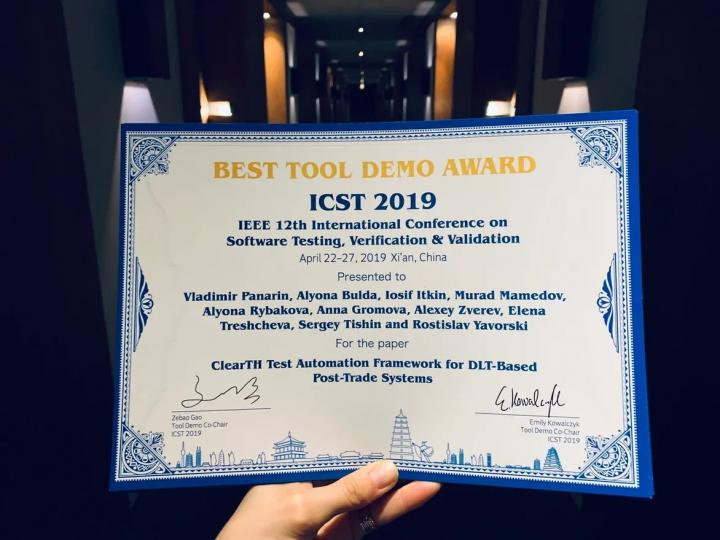
ClearTH Test Automation Framework: A Running Example of a DLT-Based Post-Trade System

The paper presents an overview of a test automation framework aimed at end-to-end functional and non-functional testing of DLT-based hybrid financial software for post-trade. The proposed solution comprises the components designed for testing user-facing parts of the SUT as well as business logic specific for different DLT-based architectures. This combined approach is seen as a viable solution of the problem of the SUT complexity as well the variety of possible DLT architectural decisions.

Read more

User-Assisted Log Analysis for Quality Control of Distributed Fintech Applications

Testing of distributed systems is a complex task, which is hampered by the impossibility of guaranteed reproduction of errors associated with race conditions. Even minor instrumentation of the system significantly changes its characteristics, which becomes critical, especially for load testing. All of that increases the importance of quality control methods based on the system log analysis. In this paper, we present our experience of semi-automated analysis of the behavior of clearing and settlement system by utilizing its logs for the purpose of identifying and classifying errors.

Read more